

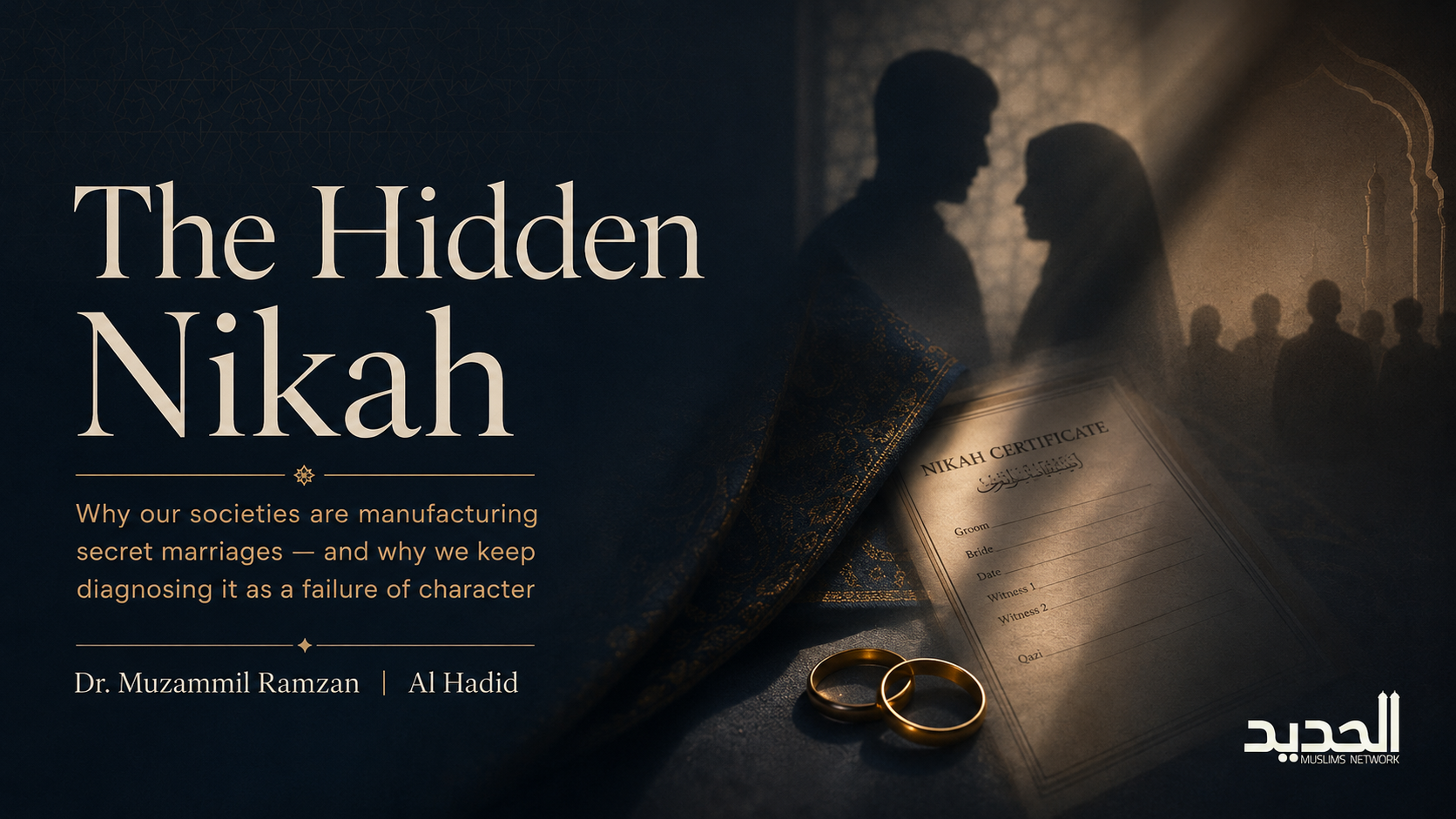
I. The question we keep asking wrongly
Sit in any gathering of teachers, ulama, or physicians in Pakistan today and you will hear a version of the same lament: that young women have become undiscerning, that standards have collapsed, that a generation is entering concealed relationships and calling it courage.
The observation is not imaginary. Something has genuinely shifted. Secret nikah, court marriage, undocumented unions, relationships conducted entirely in the dark — these are real, they are increasing, and they end badly with grim regularity.
But the diagnosis attached to the observation is wrong, and its wrongness is the reason three decades of sermons have changed nothing.
The standard explanation locates the cause inside female character: less haya, less deen, less discipline. This is a unilateral attribution for a dyadic, institutional phenomenon. It is the diagnostic equivalent of asking why patients keep developing infections while forbidding any mention of pathogens, sanitation, or hospital protocol. You can moralise about the patient forever. The infection rate will not move.
If we want the phenomenon to stop, we must first explain it correctly.
II. What the data actually shows
Begin with the claim that standards have fallen. The measurable indicators contradict it directly.
The median age at first marriage for Pakistani women rose by 1.8 years over three decades — from 18.6 in 1990 to 20.4 in 2017. The proportion of women married before eighteen fell from 50 percent in 1990–91 to 39 percent by 2017–18. Women are marrying later, not earlier; refusing more, not fewer. Gallup N-IUSSP
Now consider exit behaviour. Union Councils in Lahore alone issued more than 11,000 khula certificates in 2021, over 13,000 in 2022, over 14,000 in 2023, and more than 16,000 in 2024. Across Punjab's districts the combined divorce rate has risen roughly 35 percent in five years, with khula filings by women exceeding talaq filings by men by about 25 percent. The Express Tribune Stop Harassment Now
Read those two trends together. A population that is delaying marriage longer and dissolving unsatisfactory marriages in record numbers is not a population with collapsing standards. It is a population with rising standards operating inside a system that cannot satisfy them.
What has actually collapsed is something else entirely.
III. The price of the halal path
Here is the mechanism, stated plainly.
The Sunnah nikah is nearly free. The cultural nikah is ruinous.
The Shari'ah requires: ijab and qubool, two witnesses, mahr, and public announcement. Total cost: negligible.
Pakistani biradari practice requires: jahez, barat, mehndi, multiple functions, salami, a furnished house, a settled income, and clearance from the caste-and-clan filter. Total cost: routinely two to four years of household income.
Egypt has been studied more rigorously than we have. Singerman and Ibrahim's landmark work found that the cost of marriage there averages roughly eleven times annual household expenditure per capita, producing a "nuptiality transition" of delayed marriage and rising celibacy. Delayed marriage in Egypt then produced exactly what we are now seeing here: a documented rise in 'urfi marriages and extramarital relationships. Academia.edu Springer
Understand the structure of what we have built. We have priced the licit route at two million rupees and the concealed route at zero, and then expressed astonishment that the young walk downhill.
This is not a moral crisis. It is an incentive gradient, and it obeys the same logic in Lahore that it obeys in Cairo.
IV. Five societies. One institution.
If the cause were declining female character, the phenomenon would be culturally specific and would appear where morality had declined. It is not, and it does not. The identical institution appears independently wherever marriage becomes expensive and delayed:
Society Local form Documented driver Egypt زواج عرفي — 'urfi High marriage cost forcing years of delay in a society prohibiting premarital relations Wikipedia
Indonesia nikah siri Registration cost, guardian refusal Iran صیغه — sigheh Institutionalised temporary contract Turkey imam nikahı Civil–religious registration gap Pakistan secret nikah / court marriage Jahez inflation, biradari endogamy, wali refusal
Five legal systems. Five literacy profiles. Five completely different religious establishments. One identical institution.
No theory resting on the moral decline of women can explain that convergence. A theory resting on marriage-market economics predicts it precisely — which is what a correct diagnosis is supposed to do.
V. The verification collapse
The second cause is technological, and it is the one almost nobody names.
Every civilisation in history operated a courtship verification institution. Ours was the rishta system: khandan enquiry, mohalla reputation, chaperoned observation, the aunt who knew the family for thirty years. It was slow, often unjust, frequently cruel — and it performed one function superbly. It was a distributed background check. A man's character was verified by people who had watched him for a decade before any woman was asked to evaluate him.
That institution has been dissolved. Nothing has replaced it.
Consider what a digital channel transmits and what it conceals:
Transmits well: wit, responsiveness, verbal warmth, curated self-presentation, apparent religiosity, emotional availability on demand.
Transmits not at all: how he behaves under financial stress, how he speaks to subordinates, his conduct toward his mother, his temper at two in the morning, whether his salah exists when nobody is watching.
Now observe which traits fall into which column. Charm is front-loaded; character is back-loaded. The behavioural markers associated with manipulative personality structures — rapid rapport-building, mirroring, intense early attention, manufactured intimacy — are precisely the traits that survive transmission through text. The markers of sound character — patience, restraint, financial discipline, reliability under pressure — require longitudinal observation and transmit almost nothing.
Add Suler's well-documented online disinhibition effect: asynchronous, invisible, dissociative communication accelerates self-disclosure dramatically. Two people reach the emotional depth of a six-month acquaintance in eleven days, with none of the behavioural evidence that normally accompanies that depth.
Emotional intimacy has been decoupled from behavioural verification.
What we are calling "low standards" is, in the overwhelming majority of cases, a normal standard applied to a corrupted information channel. She did not lower the bar. She was handed a measuring instrument that reads charm and cannot read character.
VI. Why unstable men produce stronger attachment than stable ones
This is the hardest finding in the literature, and it is the one that must be taught clinically rather than preached.
Skinner established that a variable-ratio reinforcement schedule produces stronger and far more persistent attachment than a continuous one. Unpredictable reward generates larger dopaminergic prediction-error signals than reliable reward. This is why gambling is more compulsive than salaried work.
Apply it to courtship.
The man of stable character delivers continuous reinforcement: consistent warmth, predictable presence, dependable respect. Neurologically, this habituates. It becomes background.
The manipulative man delivers variable reinforcement: overwhelming attention, sudden withdrawal, return, withdrawal again. Neurologically, this sensitises. It becomes compulsive.
The uncomfortable conclusion:
Good character produces a weaker affective signal than inconsistent character. She is not choosing badness. She is responding to a reinforcement schedule that her nervous system was never taught to recognise.
This single mechanism explains more variance in poor partner selection than every moral explanation combined — and unlike moral explanations, it points to an intervention. A conditioning schedule that can be named can be resisted. One that is never named cannot.
VII. Why concealment holds people captive
Once the secret nikah exists, three mechanisms close around it.
Escalation of commitment. Reputation has already been risked. Withdrawal means the risk was taken for nothing, so the mind protects the investment.
Dissonance resolution. She must now believe he is worthy — the alternative account, that she surrendered her standing to an unworthy man, is intolerable. So she manufactures his worth internally, and defends it externally.
Exposure asymmetry. In our culture, disclosure devastates her social position far more than his. This is the decisive point. Secrecy is not a shared shelter. Secrecy is leverage, and it points in one direction only. The moment concealment becomes permanent, the arrangement has converted from a private choice into a control structure.
And this is where the language of "himmat" appears — usually afterward, never before. Two mechanisms generate it: moral licensing, in which the presence of a partial Islamic act (the nikah) is used to sanctify the whole arrangement including the concealment that voids it; and post-hoc narrative repair, because the mind will not tolerate the account "I was outmanoeuvred" when the account "I was brave" is available at no cost.
The courage story is not a cause of the secret nikah. It is a symptom of it.
VIII. What the Shari'ah actually requires
Here the argument becomes unanswerable, and this is the ground on which it should be fought — not the ground of morality, which produces defensiveness, but the ground of law, which produces silence.
I'lan — public announcement — is a requirement, not an ornament. The Sunan collections record the Prophet ﷺ commanding that nikah be announced and made publicly audible. On the strength of this, the Maliki school holds that a marriage contracted with an instruction of concealment is invalid and subject to faskh. Imam Malik records in the Muwatta that Sayyiduna 'Umar ibn al-Khattab رضي الله عنه was brought a marriage witnessed in concealment, named it a secret marriage, and refused to permit it.
Note what publicity is for. It is not ceremony. It is the evidentiary foundation of every right a wife possesses:
Right the nikah is supposed to secure Requires provable, public nikah Nafaqah — maintenance Yes Enforcement of mahr Yes Nasab — legitimate lineage of children Yes Inheritance Yes Khula or judicial dissolution Yes Registration under MFLO 1961 Yes
Now state the conclusion without any moral accusation whatsoever:
A concealed nikah gives a woman every obligation of a wife and the legal standing of a stranger. It is not courage. It is the transfer of one hundred percent of the risk onto the party with the least social capacity to absorb it.
Egypt's experience is instructive: legislation there eventually recognised a woman's right to seek dissolution of an 'urfi marriage, but denied her alimony and child support. The concealment survives the relationship and continues to injure her after it ends. Answering Islam
Present it this way and the "himmat" narrative collapses on its own, without a single sermon.
IX. The remedy the Shari'ah already provided
Almost nobody in Pakistan teaches this, and it is arguably the single highest-leverage fact in this entire discussion.
When a wali refuses a suitable match without shar'i cause, he becomes 'adl — an unjust guardian — and his wilayah lapses. Authority transfers to the qadi. The Prophet ﷺ said that the ruler is the guardian of one who has no guardian. The Shari'ah anticipated the obstructive family fourteen centuries ago and opened a door: judicial escalation, not concealment.
Under Hanafi fiqh, the dominant school in Pakistan, an adult sane woman possesses the capacity to contract her own nikah. Pakistani law affirms this: the Lahore High Court full bench in Hafiz Abdul Waheed v. Asma Jehangir (PLD 1997 Lahore 301) held that an adult Muslim woman may validly contract marriage without her wali's consent.
Consider what this means. The secret was never necessary. There existed, the entire time, a lawful, public, protected route — and a generation went underground because no one taught them it existed. That is not a failure of female character. It is a failure of our teaching, and it belongs to us.
X. What is genuinely within individual control
A purely structural analysis that erases moral agency is as false as a purely moral one that erases structure. Four factors are real and individual:
Fiqh illiteracy specific to marriage. Most educated Muslim women can cite five texts on hijab and none on wali 'adl, mahr enforcement, or their right to insert binding conditions into the nikahnama. The nikahnama left blank. Columns 17 to 20 — special conditions, delegation of the right of divorce (tafweed-e-talaq), restriction of the husband's unilateral talaq, and marriage settlement — are struck through or ignored in the overwhelming majority of Pakistani marriages. These clauses are legally binding and cost nothing. Verify the exact form for your province, then never sign one blank again. Tarbiyah distinguished from information. Knowing a ruling and possessing the internal capacity to act against immediate emotional reward are different faculties. We teach the first and assume the second. Confusion of intensity with sincerity — culturally manufactured by the entire romantic canon of our drama and poetry, in which obsession is coded as devotion and possessiveness as love.
Deception detection is a learnable clinical skill. Love-bombing, mirroring, isolation, manufactured urgency, intermittent withdrawal — these have recognisable signatures. They are taught nowhere in the Pakistani educational system, at any level.
XI. What must change
Families: Every rupee added to a wedding raises the marginal attractiveness of concealment. The jahez economy is a pre-Islamic tribal residue wearing an Islamic garment. It is reported that the most blessed nikah is the one of least expense. Attack the price, and the secret marriage rate falls without a single sermon.
Ulama and khateebs: Teach i'lan as a condition, teach wali 'adl as a remedy, and teach kafa'ah as the narrow protection it originally was rather than the caste filter it has become.
Educators and clinicians: Teach reinforcement schedules and manipulation detection as a diagnostic module — the way we teach differential diagnosis. Not "beware of bad men," but: this is the conditioning mechanism, this is why sound character generates a weaker signal, and this is how a person compensates for it deliberately.
Institutions: Rebuild a verification layer. The old rishta system's function was sound even where its execution was unjust. Something must perform that function, or the digital channel will keep selecting for charm and filtering out character.
XII. Conclusion
The generation before us did not possess superior morality. It possessed superior infrastructure — an affordable licit path and a functioning verification system. We dismantled both, kept the prohibitions, and then explained the resulting behaviour as a defect of character in the people caught between them.
Stated precisely:
The digital age did not lower anyone's standards. It destroyed the infrastructure that made standards enforceable, while inflating the price of the licit path beyond the reach of the young. Standards without verification, and prohibition without an affordable lawful exit, produce exactly the pattern we now observe — in Lahore, in Cairo, in Jakarta, identically.
Concealed marriage is not a moral mystery. It is the predictable output of a system we built ourselves. Which means it is a system we can dismantle — and that is a far more hopeful conclusion than the one we have been preaching.
About the author: Dr. Muzammil Ramzan (BEMS) | Founder of Al Hadid
By Dr. Muzammil Ramzan | Al Hadid Integrative Medicine & Professional Education
Related department
Islamic Studies